
Photographing bees can be a real challenge. They tend to move pretty fast, and often they turn out not to be a bee at all. So here’s some bees, some hoverflies, and some hornets. These photos were taken with a combination of the old Canon 700d with a Canon EF 70-300mm II IS USM lens, and more recently, the Canon R7 with RF 100-400mm lens. Some of the bees on the pond were actually taken with my Pixel 7a. You’ll note some editing fails here, such a vignettes that are too strong, but overall, I think I am improving – and I’m having a lot of fun in the process!
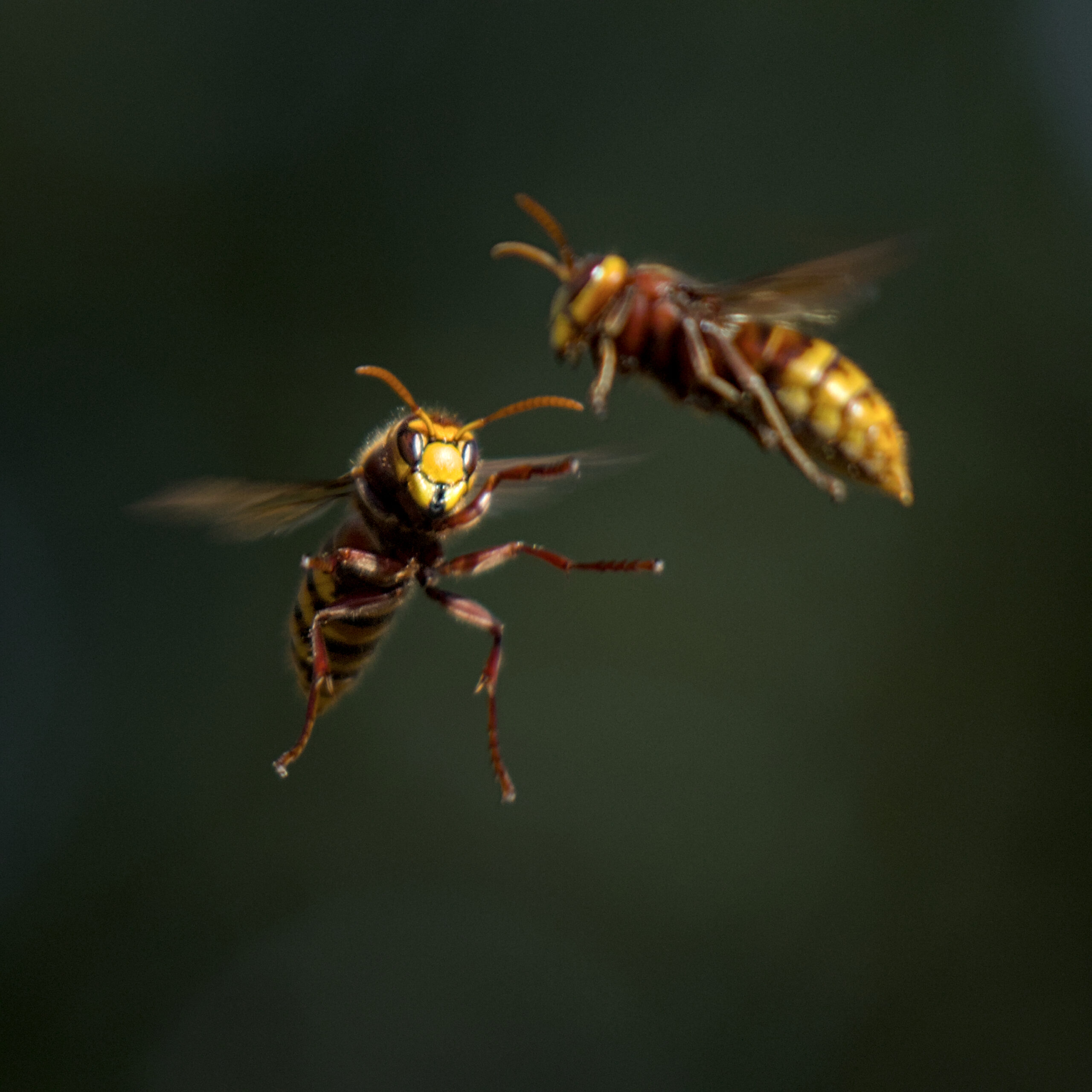
The hornets in flight were some of the first photos I took with my Canon R7, and they turned out good – one scored 19/20 at the camera club!
Here’s what I’ve photographed.
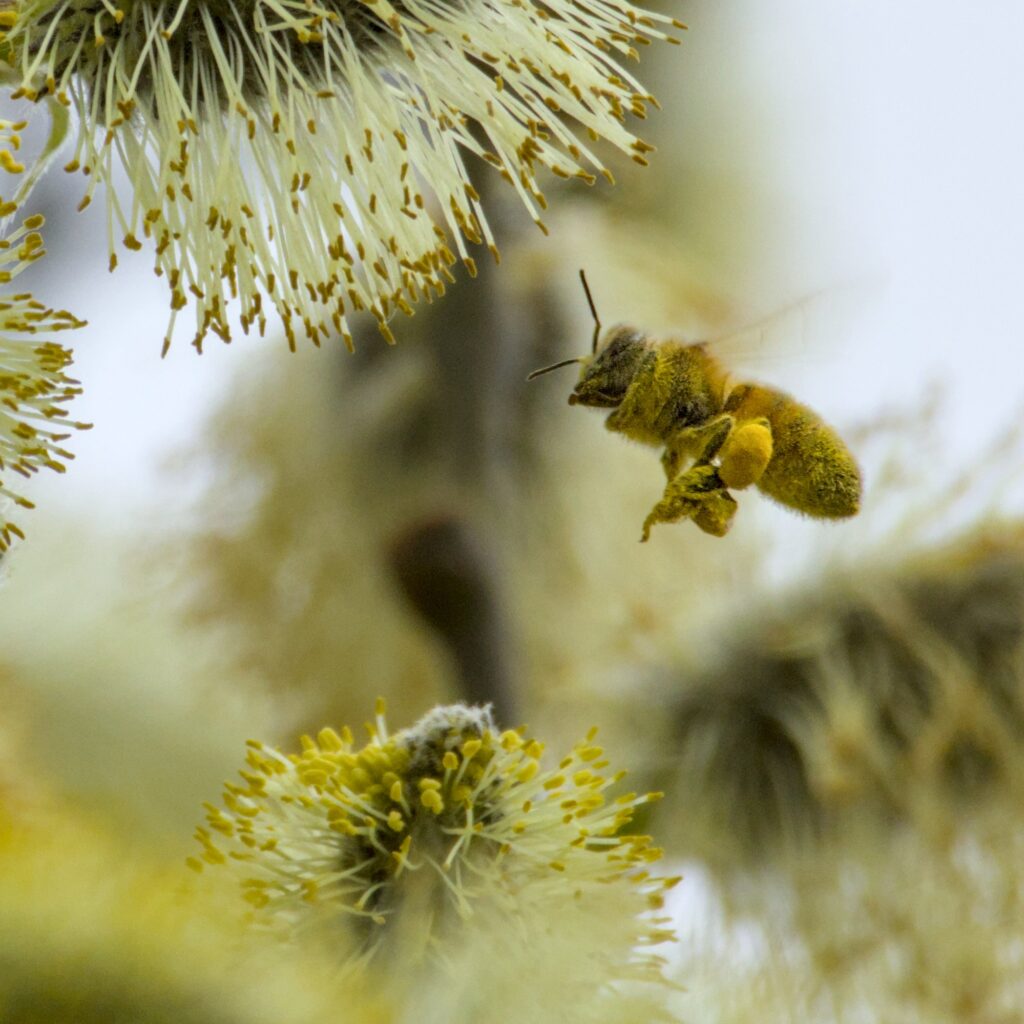
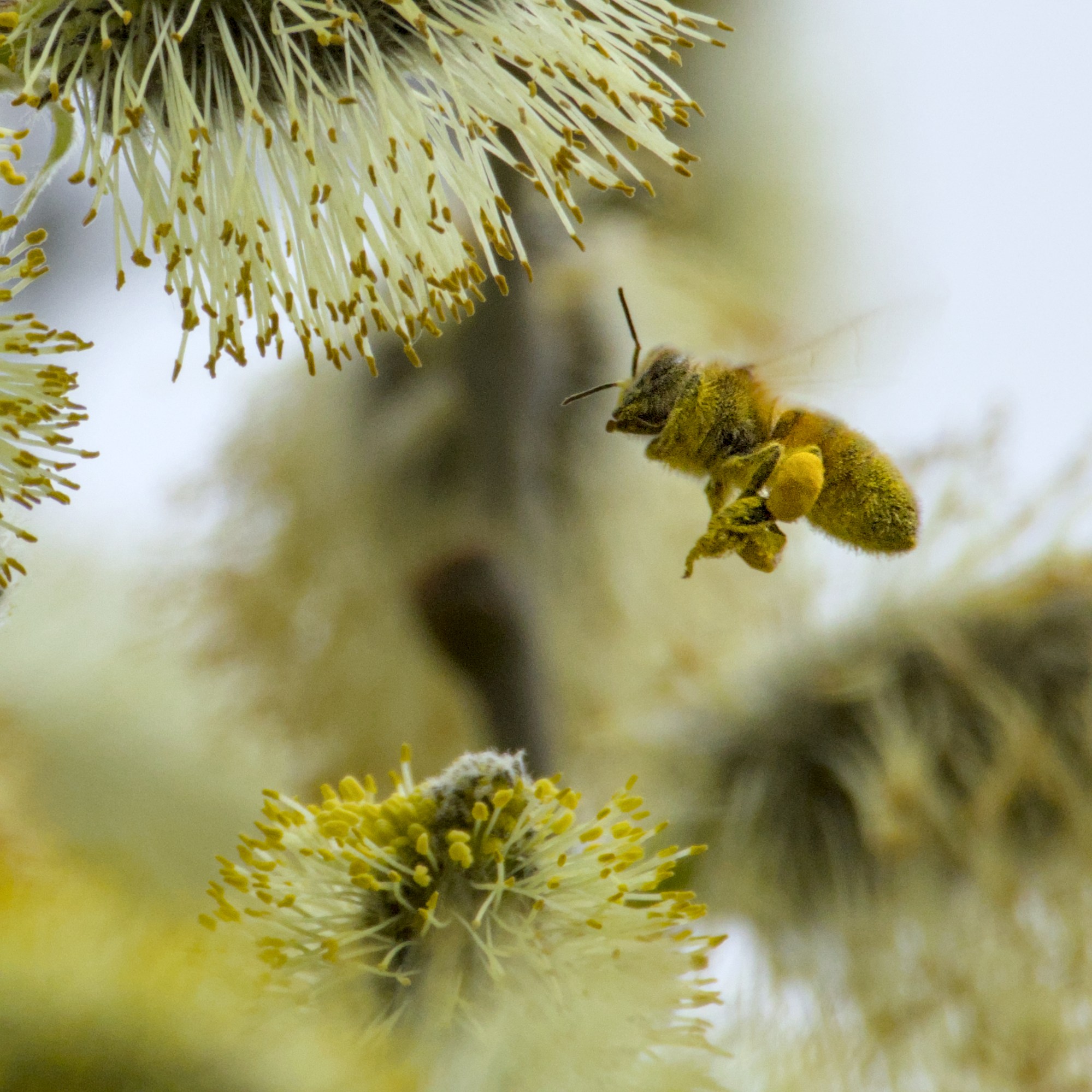
Featured Image — Honey Bee in Flight among Willow Catkins
Western Honey Bee — Apis mellifera
The Plant
Willow — Salix sp. (probably Goat Willow / Pussy Willow — Salix caprea)
Willow catkins are one of the most important early pollen sources for bees in the UK, flowering from February through April before most other plants have woken up. For colonies emerging from winter with dwindling reserves, a willow tree in full catkin is genuinely life-saving. Goat Willow in particular produces prodigious quantities of pollen — as this photograph makes abundantly clear.
The Bee
This image rather speaks for itself. The bee is so thoroughly coated in bright yellow willow pollen that it’s almost unrecognisable — every hair on its body acting as a tiny pollen trap, exactly as nature intended. The bulging pollen basket on the hind leg shows it has already been working these catkins hard. Catching a bee in flight and sharp is challenge enough — catching one this gloriously pollen-dusted, mid-hover between catkins, is something I’m particularly proud of. Taken at Phyllis Currie Nature Reserve in March 2026.
- Scientific name: Apis mellifera
- Common name: Western Honey Bee
- Plant: Goat Willow / Pussy Willow — Salix caprea
- Season: March — one of the earliest foraging opportunities of the year
- Location: Phyllis Currie Nature Reserve, Essex
- UK Status: Very common; willow is one of the most important early-season plants for pollinators
- ⚠️ ID Note: I’m confident this is a Honey Bee despite the extraordinary pollen coating — the body shape and size are unmistakable. The plant I’m less certain on — Goat Willow is my best guess for the catkin structure, but there are many willow species and hybrids and I’d welcome confirmation!
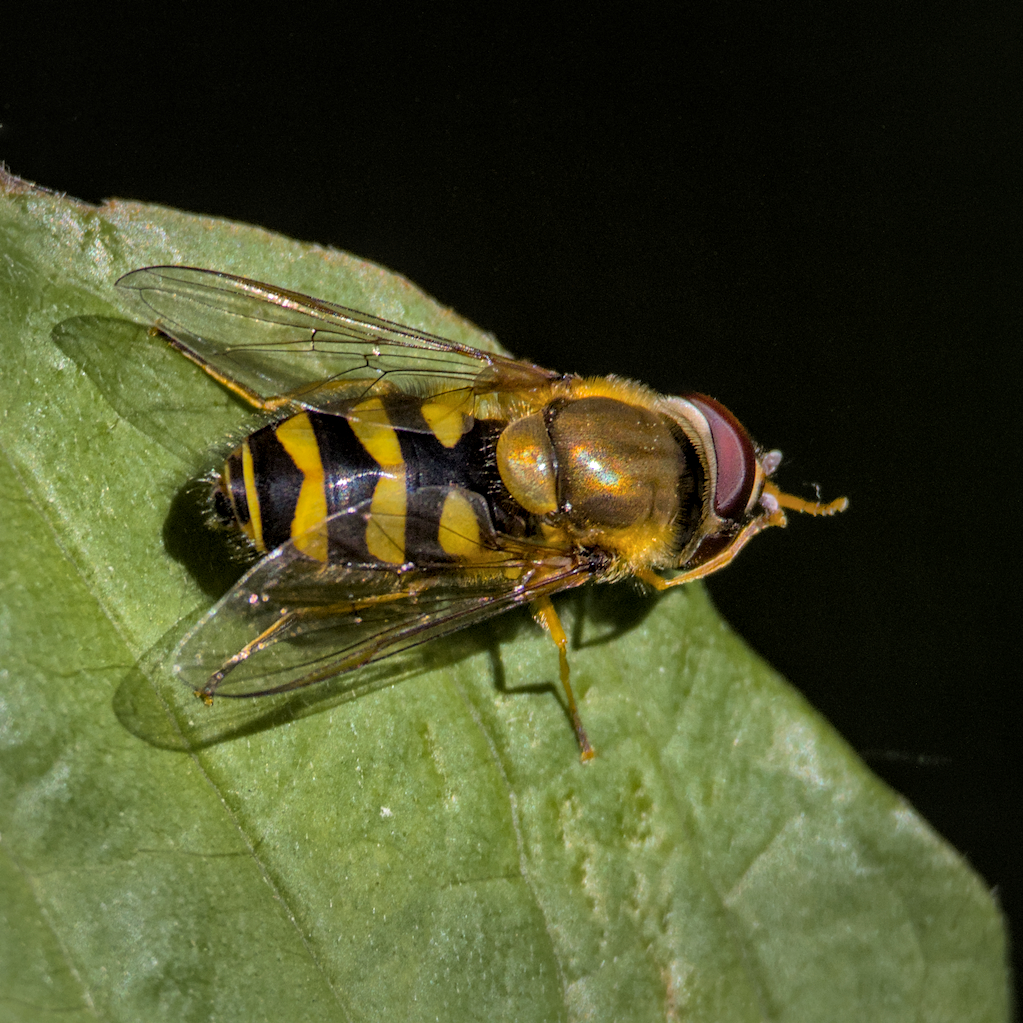
Image 1 — Hoverfly on Leaf
Hornet Hoverfly — Volucella zonaria (provisional ID — see note)
Britain’s largest hoverfly, and one of its most impressive insects. Volucella zonaria is a superb mimic of the European Hornet, which grants it protection from predators despite being entirely harmless. The broad yellow and black banding, chestnut-brown thorax, and large reddish compound eyes are all highly characteristic. Originally a rare vagrant from the continent, it has colonised southern England in recent decades and is now well established, particularly in the south-east. Adults are strong fliers commonly found nectaring on flowers or basking on sunny leaves. Larvae develop inside the nests of social wasps and hornets, scavenging on nest debris — a remarkable lifestyle for such an elegant insect.
- Scientific name: Volucella zonaria
- Common name: Hornet Hoverfly
- Season: June–October
- Habitat: Gardens, parks, woodland edges, hedgerows — particularly in southern England
- UK Status: Locally common in the south; range expanding northward
- ⚠️ ID Note: I’m reasonably confident on this one given the size and colouration, but I’m no hoverfly expert and would love a second opinion — please leave a comment if you can confirm or improve on this!
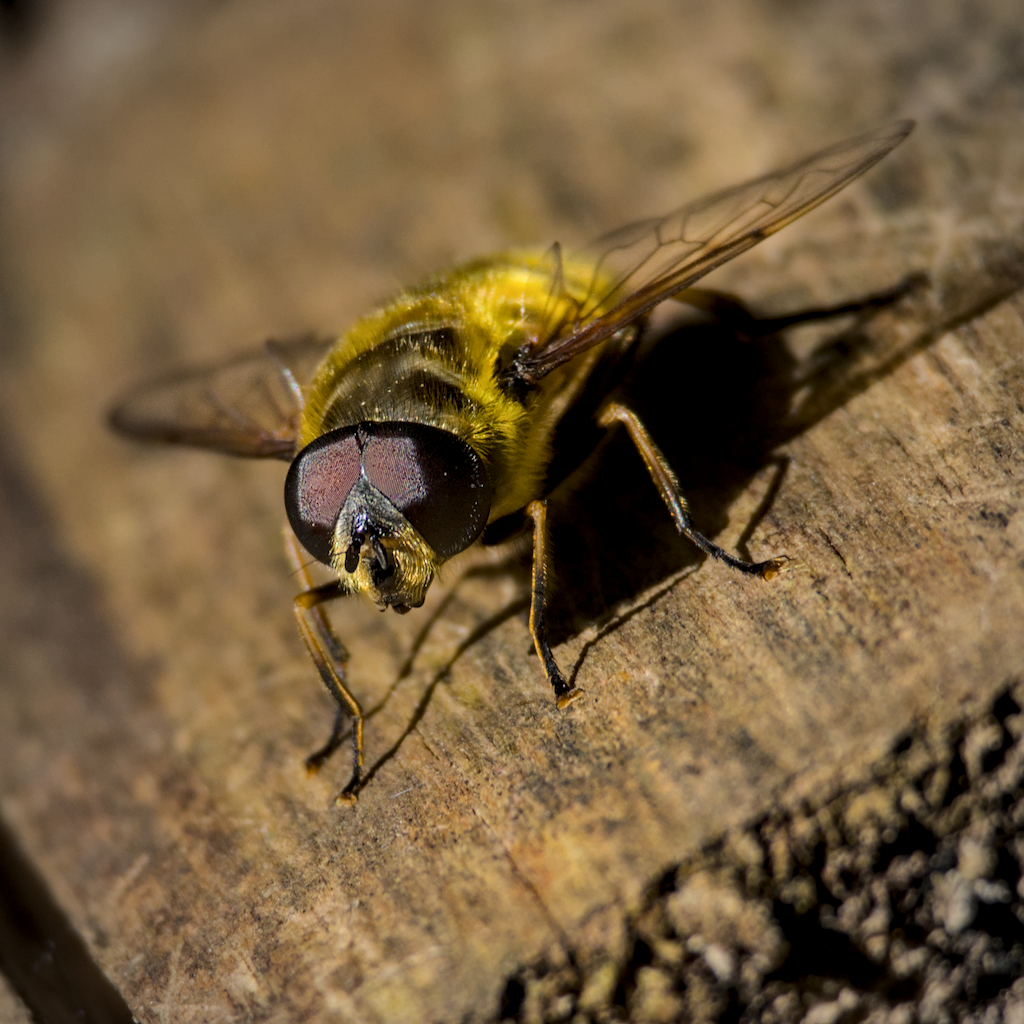
Image 2 — Furry Yellow Hoverfly on Wood
Narcissus Bulb Fly — Merodon equestris (provisional ID — see note)
This wonderfully fluffy, bumblebee-mimicking hoverfly is one of the most variable species in Britain, coming in several colour forms that mimic different bumblebee species. The dense yellow-orange hair on the thorax, stout build, and large eyes are consistent with Merodon equestris. Despite its charming appearance it has a darker side — larvae develop inside bulbs, particularly narcissus, and can be a significant garden pest. Adults are commonly found on flowers and sunny surfaces in spring and early summer, and this one seems perfectly content on a warm piece of timber.
- Scientific name: Merodon equestris
- Common name: Narcissus Bulb Fly / Large Narcissus Fly
- Season: April–July
- Habitat: Gardens, meadows, woodland edges — wherever bulbs are present
- UK Status: Common and widespread
- ⚠️ ID Note: Merodon equestris is highly variable and can be confused with several bumblebee species and other hoverflies. I’m not confident beyond a provisional ID here — if you know better, please do leave a comment!*
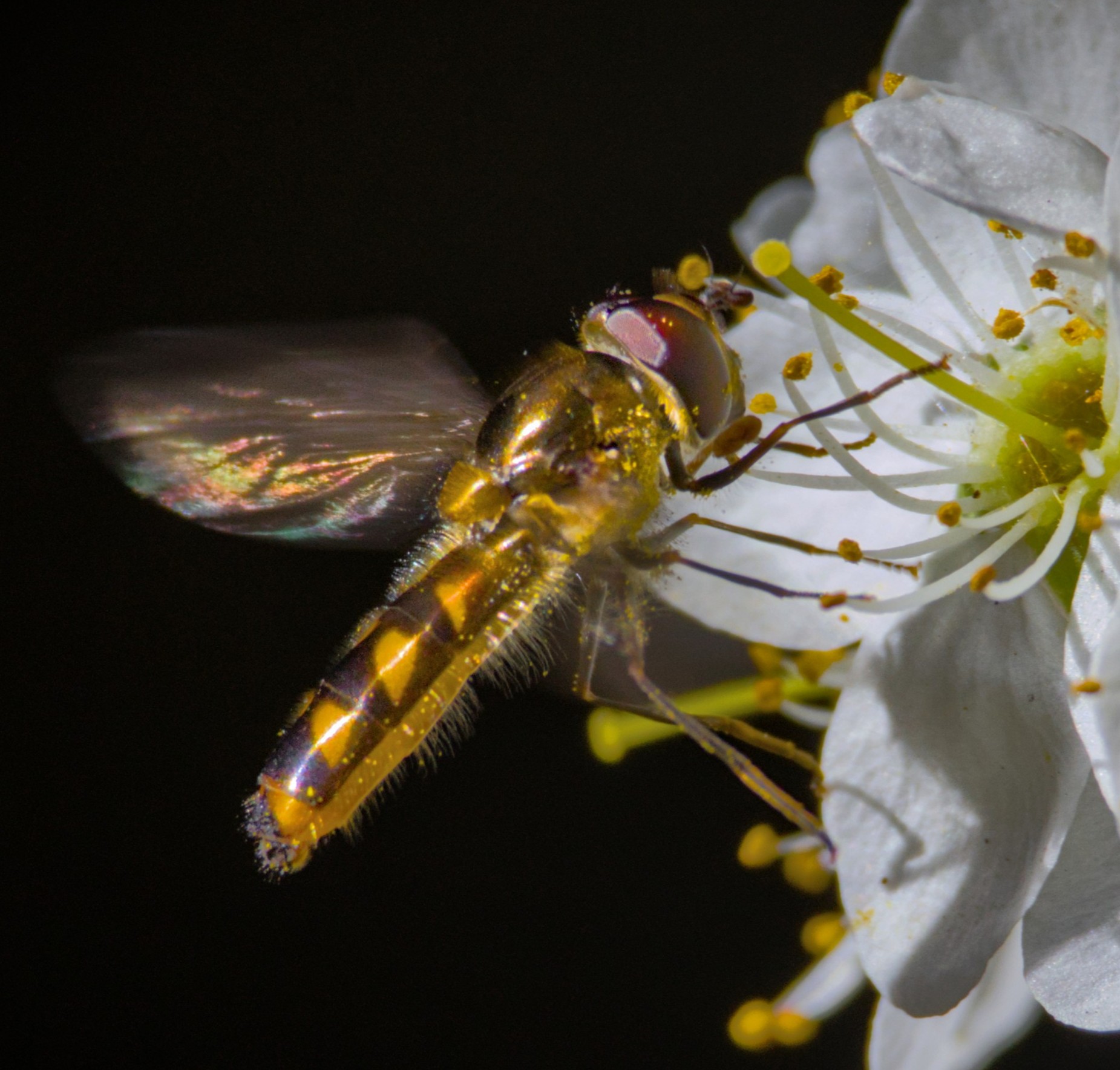
Image 3 — Golden Hoverfly on White Blossom
Marmalade Hoverfly — Episyrphus balteatus (provisional ID — see note)
One of Britain’s most familiar and abundant hoverflies, the Marmalade Hoverfly is a slender, elegant species with distinctive double dark bands on the abdomen and rich orange-gold colouration. This is one of my favourite shots from this set — wings blurred with motion, body already dusted with pollen from the white blossom, which I believe is blackthorn or cherry. Episyrphus balteatus is one of the UK’s most important pollinators and also a significant migrant, with millions arriving from the continent each autumn. Its larvae are voracious aphid predators, making this species a genuine friend to gardeners.
- Scientific name: Episyrphus balteatus
- Common name: Marmalade Hoverfly
- Season: March–November; migratory influxes in autumn
- Habitat: Almost everywhere — gardens, meadows, hedgerows, woodland edges
- UK Status: Extremely common; one of the most abundant hoverflies in Britain
- ⚠️ ID Note: I’m reasonably confident given the characteristic banding, but as always I’d welcome expert correction in the comments!
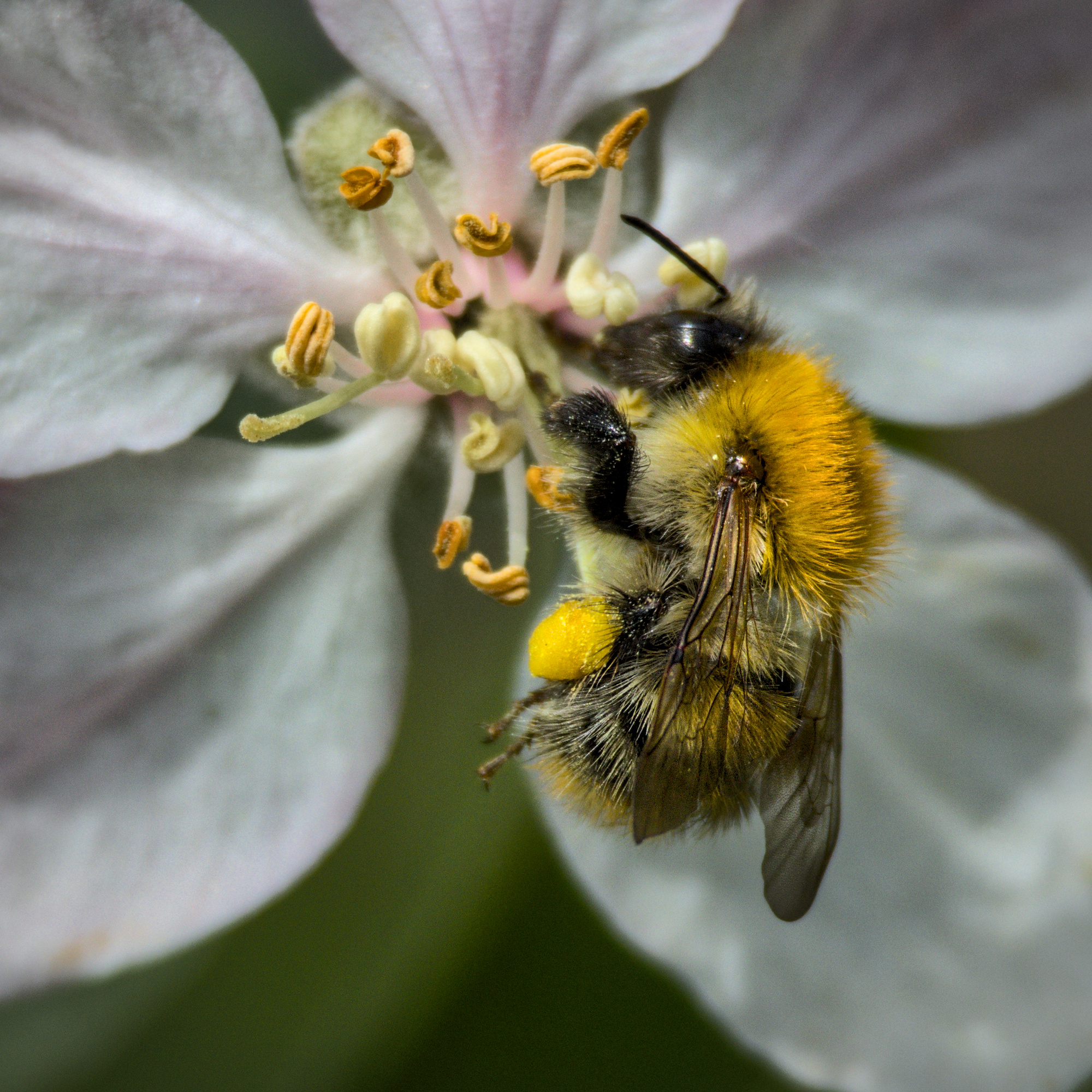
Image 4 — Bumblebee on Pink-White Blossom
Common Carder Bee — Bombus pascuorum (provisional ID — see note)
A warm, gingery bumblebee with characteristic tawny-orange fur on the thorax — Bombus pascuorum is one of Britain’s most widespread and long-seasoned bumblebees. I was particularly pleased to capture the large pollen basket (corbicula) packed with bright yellow pollen on the hind leg — a lovely detail that shows just how hard these insects work. The blossom appears to be apple or a close relative, and this species is a highly effective pollinator of orchard fruit trees.
- Scientific name: Bombus pascuorum
- Common name: Common Carder Bee
- Season: March–October; one of the latest-flying bumblebees in the UK
- Habitat: Gardens, meadows, hedgerows, farmland — highly adaptable
- UK Status: Common and widespread throughout Britain
- ⚠️ ID Note: Bumblebee identification can be genuinely tricky and I’m not a bee specialist — I’d welcome any corrections. This is my best guess based on the colouration and fur texture visible here.
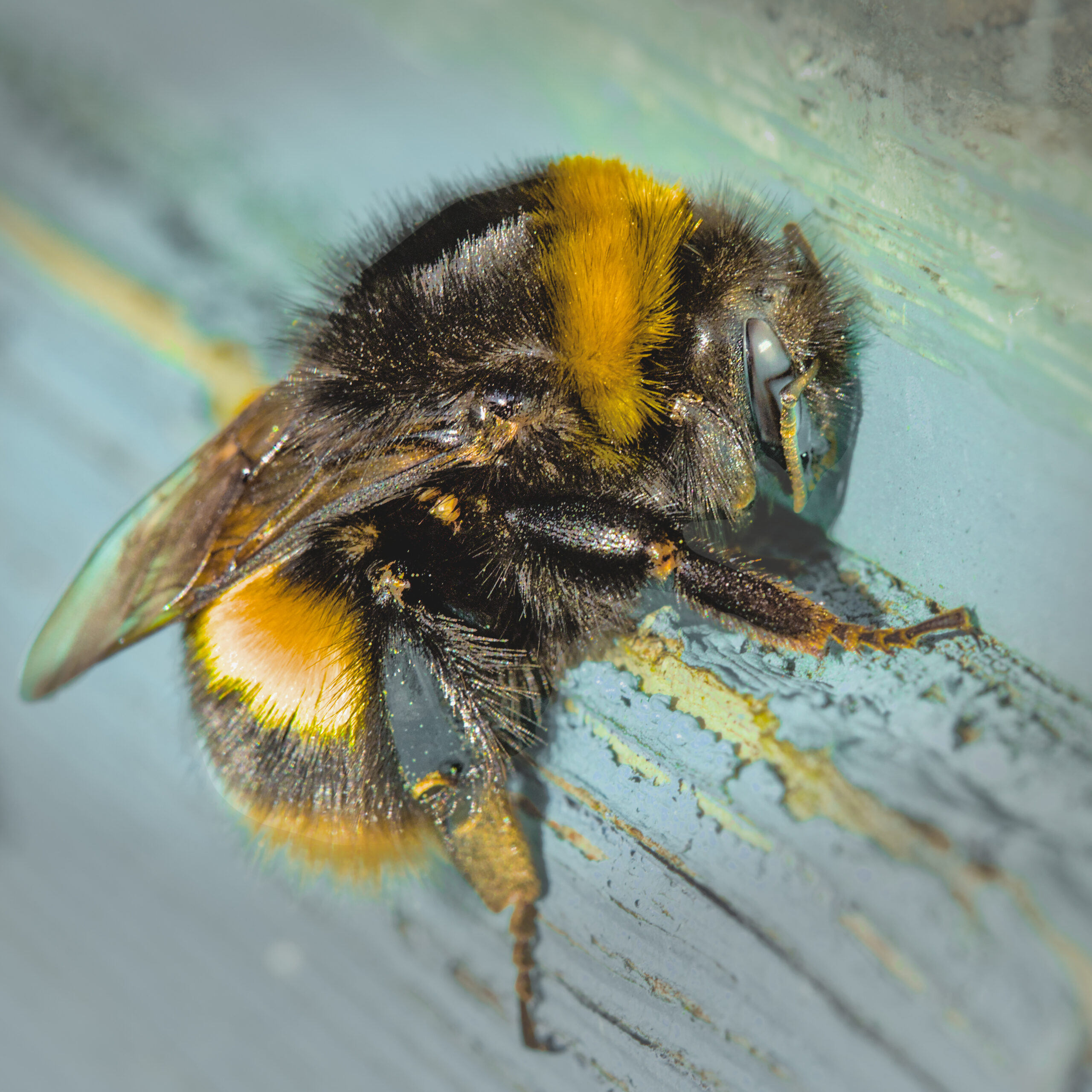
Image 5 — Dark Bumblebee Close-Up on Painted Wood
(“The Bee Awakens”)
Buff-tailed Bumblebee — Bombus terrestris (provisional ID — see note)
A dramatic close-up showing the rich golden-yellow thoracic band and deep orange-yellow tail band against an almost entirely black body — the combination points strongly toward Bombus terrestris, Britain’s largest and arguably most familiar bumblebee. I love the iridescent sheen on the wings and the detail of the individual hairs at this scale — it’s the kind of image that reminds you just how extraordinary these creatures are up close. The bee appears to be resting on peeling painted wood, perhaps a garden shed or fence, which is a common basking spot on warm days.
- Scientific name: Bombus terrestris
- Common name: Buff-tailed Bumblebee
- Season: February–October; queens sometimes seen on warm winter days
- Habitat: Gardens, farmland, meadows, hedgerows — one of the most adaptable bumblebees
- UK Status: Very common and widespread throughout Britain
- ⚠️ ID Note: Separating Buff-tailed from White-tailed Bumblebee (Bombus lucorum) can be very difficult — the tail colour is the key feature but varies with wear and light. This is a provisional ID and I’d welcome input from anyone more expert!
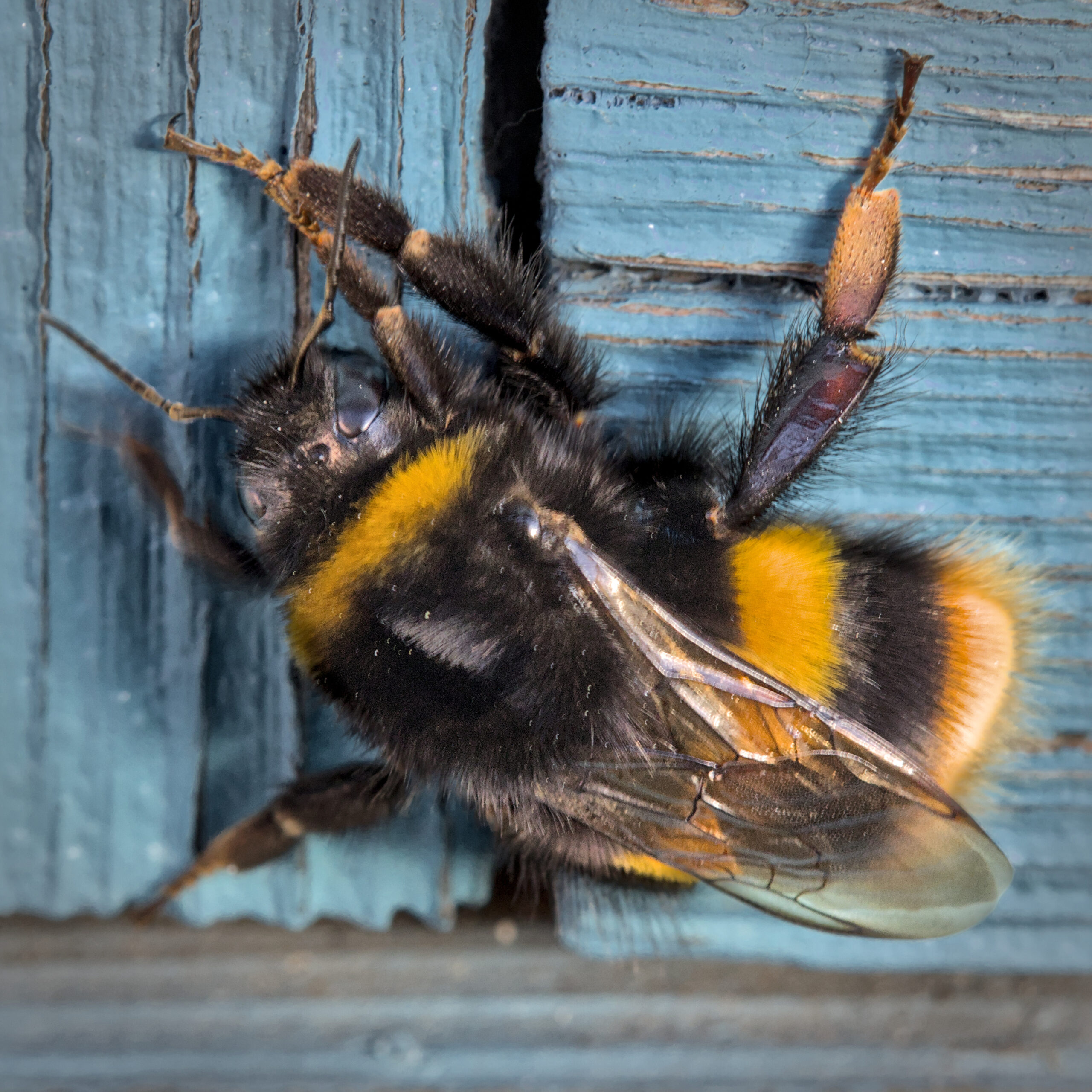
Image 6 — Bumblebee on Blue Painted Wood
Buff-tailed or White-tailed Bumblebee — Bombus terrestris / Bombus lucorum (provisional ID — see note)
Almost certainly the same species as the previous image, here photographed from below against weathered blue-painted timber — giving a wonderfully different perspective that I wasn’t expecting when I took it. The striking yellow and orange bands and the wing detail are beautifully captured, and the peeling blue paint makes for an unexpectedly attractive backdrop. The bee appears to be investigating a crack or gap — both species readily explore potential nest sites in garden structures.
- Scientific name: Bombus terrestris / Bombus lucorum
- Common name: Buff-tailed / White-tailed Bumblebee
- Season: February–October
- Habitat: Gardens, hedgerows, farmland, meadows
- UK Status: Both species very common throughout Britain
- ⚠️ ID Note: As with the previous image, I can’t confidently separate these two species from this angle — if you can, I’d genuinely love to know how!
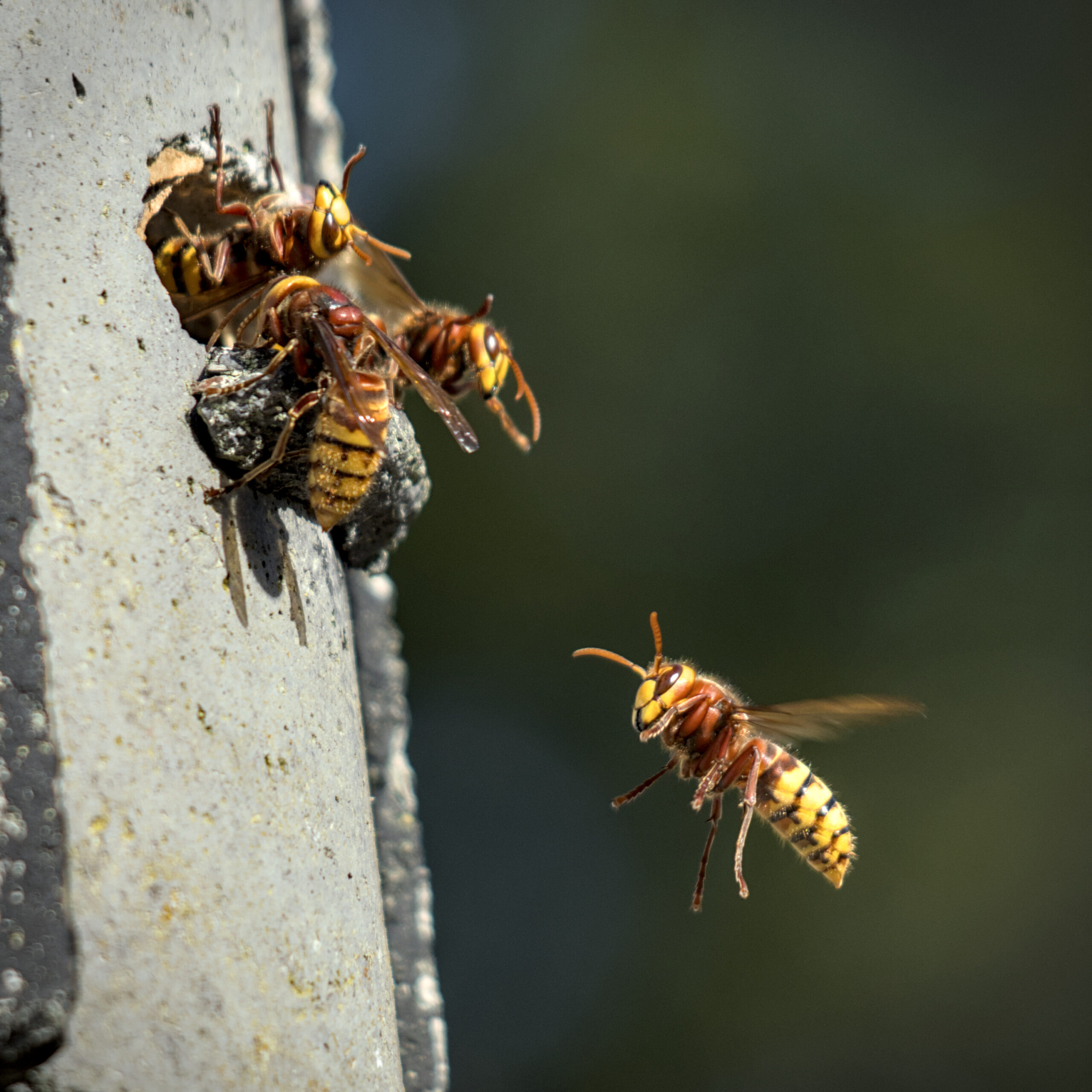
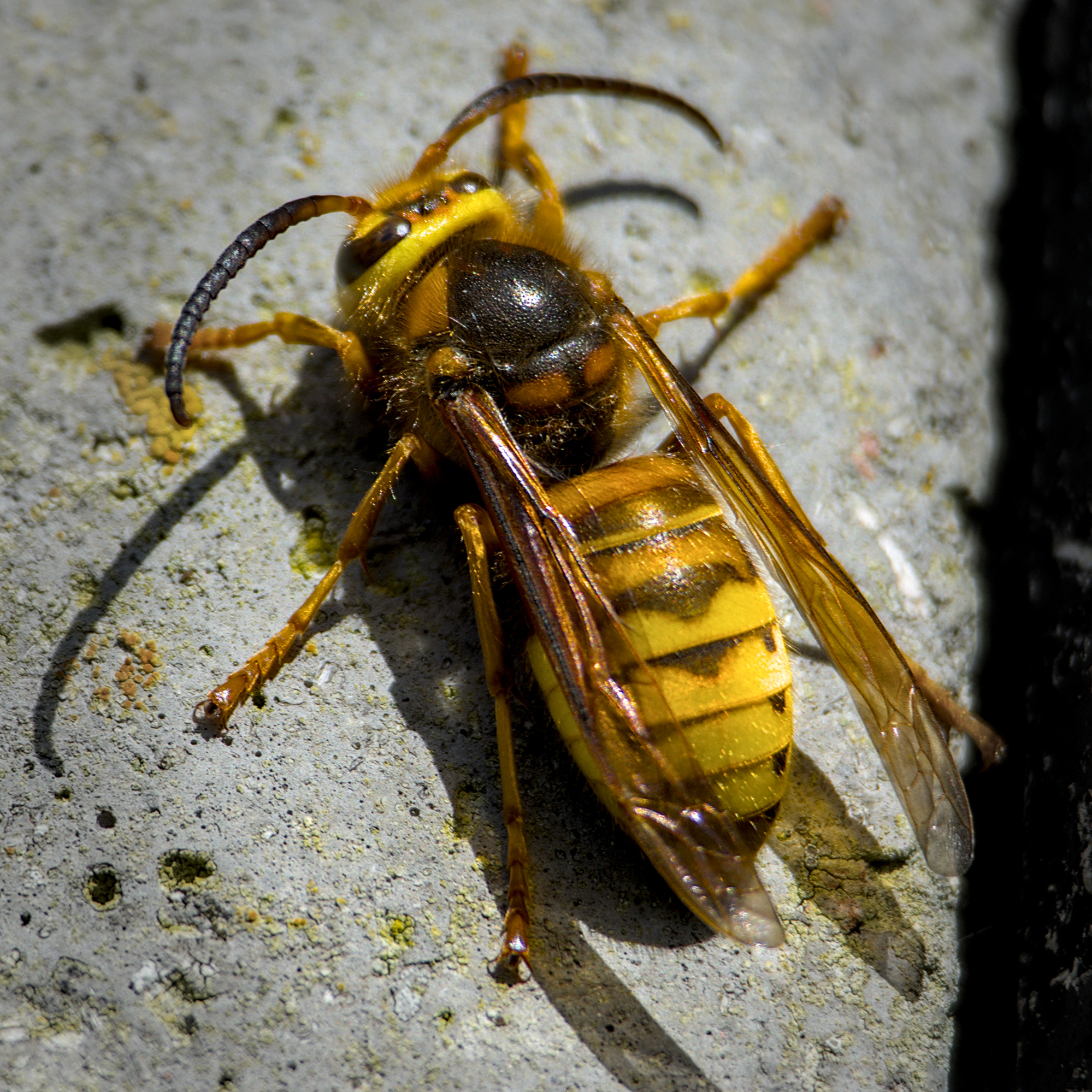
Images 7, 8 & 9 — Hornets at the Nest
European Hornet — Vespa crabro
Britain’s largest social wasp, and one of its most impressive insects — and these three images together tell a story I was incredibly lucky to capture. The first shows hornets clustered around what appears to be a nest entrance in a hollow post or wall cavity, with one launching into flight. The two-hornet in-flight shot is the one I’m most proud of in this whole gallery — getting two fast-moving hornets sharp and in frame simultaneously took a great deal of patience and quite a few failed attempts (it also scored 19/20 in my camera club competition!). The third is a detailed overhead shot of a single hornet resting on concrete, showing the warm amber and dark brown colouration that so clearly distinguishes Vespa crabro from the colder black-and-yellow of common wasps.
Despite their fearsome reputation, hornets are generally placid insects unless their nest is directly threatened — in my experience far less prone to reacting than common wasps. They are voracious predators of other insects, including large flies and other wasps, which they carry back to the nest to feed their larvae.
- Scientific name: Vespa crabro
- Common name: European Hornet
- Season: Queens emerge April; colonies active May–November
- Habitat: Woodland, parkland, hedgerows, gardens — nesting in hollow trees, wall cavities, roof spaces
- UK Status: Locally common in England and Wales; most frequent in the south
- ⚠️ ID Note: I’m confident on this one — European Hornets are unmistakable at this size and with this colouration. The only confusion species in the UK is the non-native Asian Hornet (Vespa velutina), which has a distinctly darker abdomen and should always be reported to the Non-Native Species Secretariat if you think you’ve encountered one.
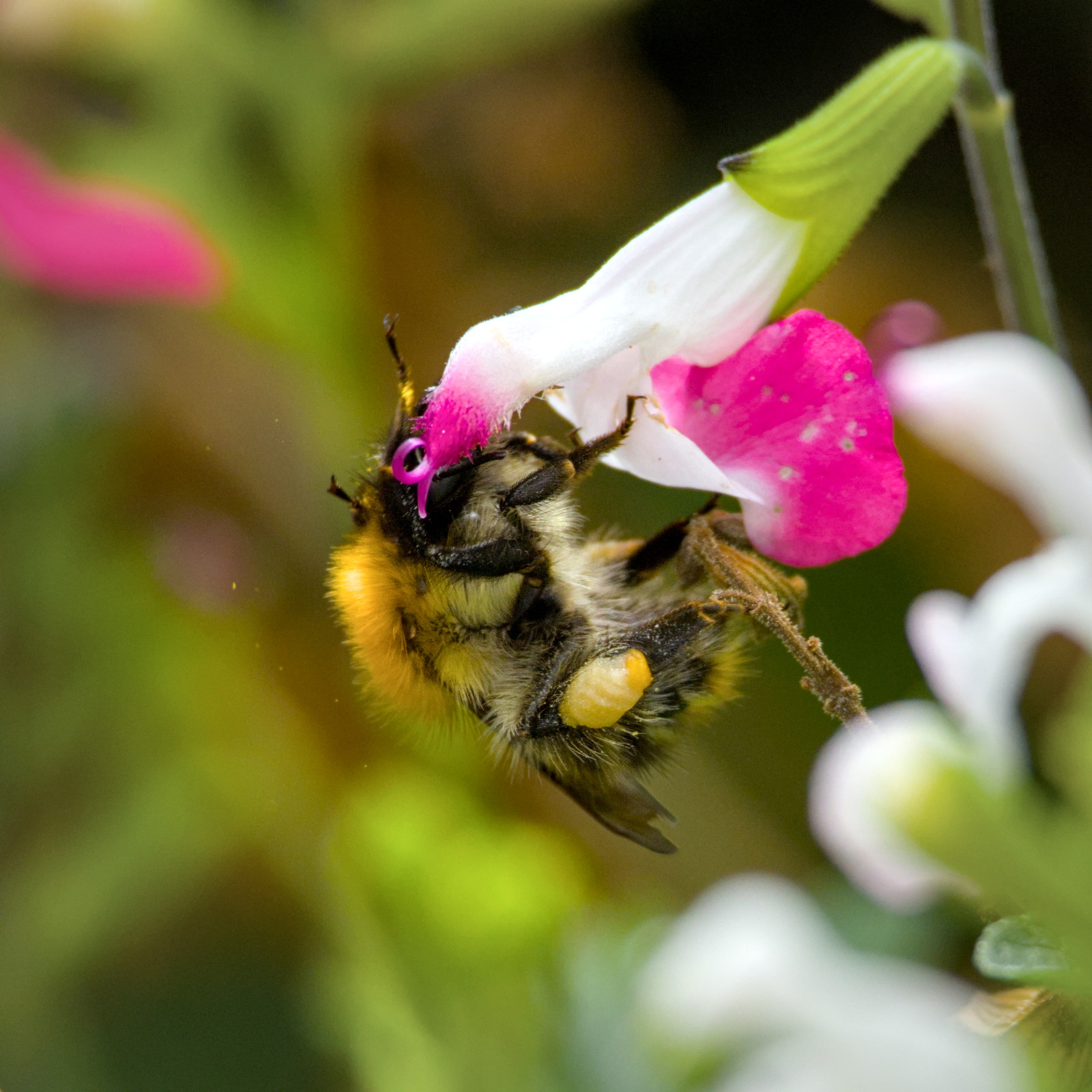
Image 10 — Bumblebee on Pink & White Salvia (close)
Common Carder Bee — Bombus pascuorum (provisional ID — see note)
Almost certainly the same species as Image 4, here caught working a garden salvia — the tubular pink and white flowers are a real magnet for long-tongued bees. I love this shot for the way it shows the bee pushing deep into the flower to reach the nectar, face already dusted with pink pollen. The pollen basket on the hind leg is clearly visible and well loaded. Garden salvias are particularly valuable for pollinators as they flower over a very long season, and I’d encourage anyone with garden space to grow them.
- Scientific name: Bombus pascuorum
- Common name: Common Carder Bee
- Plant: Garden Salvia — likely Salvia microphylla or similar
- Season: March–October
- Habitat: Gardens particularly; also meadows and hedgerows
- ⚠️ ID Note: Provisional ID — as always I welcome input from anyone more expert in bumblebee identification!
Image 11 — Wasp Drinking at Water
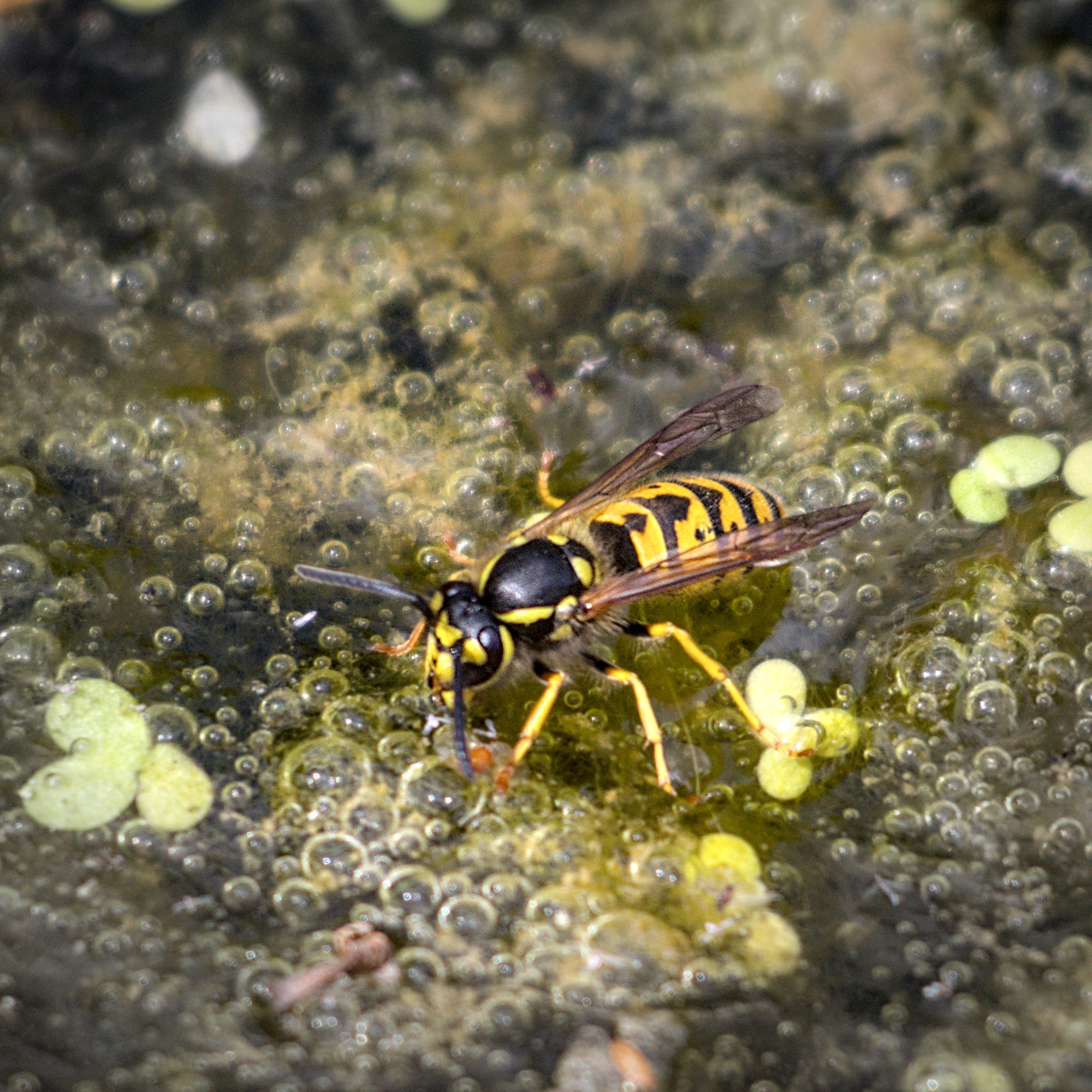
Common Wasp — Vespula vulgaris (provisional ID — see note)
A behavioural shot I was pleased to get — wasps are frequent visitors to water sources, drinking for themselves and also collecting water to help regulate nest temperature during hot weather. The classic black and yellow banding and compact body are consistent with Vespula vulgaris, our most familiar wasp. I know wasps get a bad press, and I’ll admit I used to share that view, but they are actually important predators of pest insects throughout the summer — they only become a nuisance in early autumn when the colony collapses and workers turn to scavenging for sugar.
- Scientific name: Vespula vulgaris
- Common name: Common Wasp
- Season: April–October; workers most visible July–September
- Habitat: Almost everywhere — gardens, woodland, farmland, urban areas
- UK Status: Extremely common and widespread
- ⚠️ ID Note: Vespula vulgaris and the closely related German Wasp (Vespula germanica) are very difficult to separate reliably without close examination of facial markings — any wasp experts are welcome to correct me in the comments!*
Image 12 — Bumblebee on Red Salvia (wide)
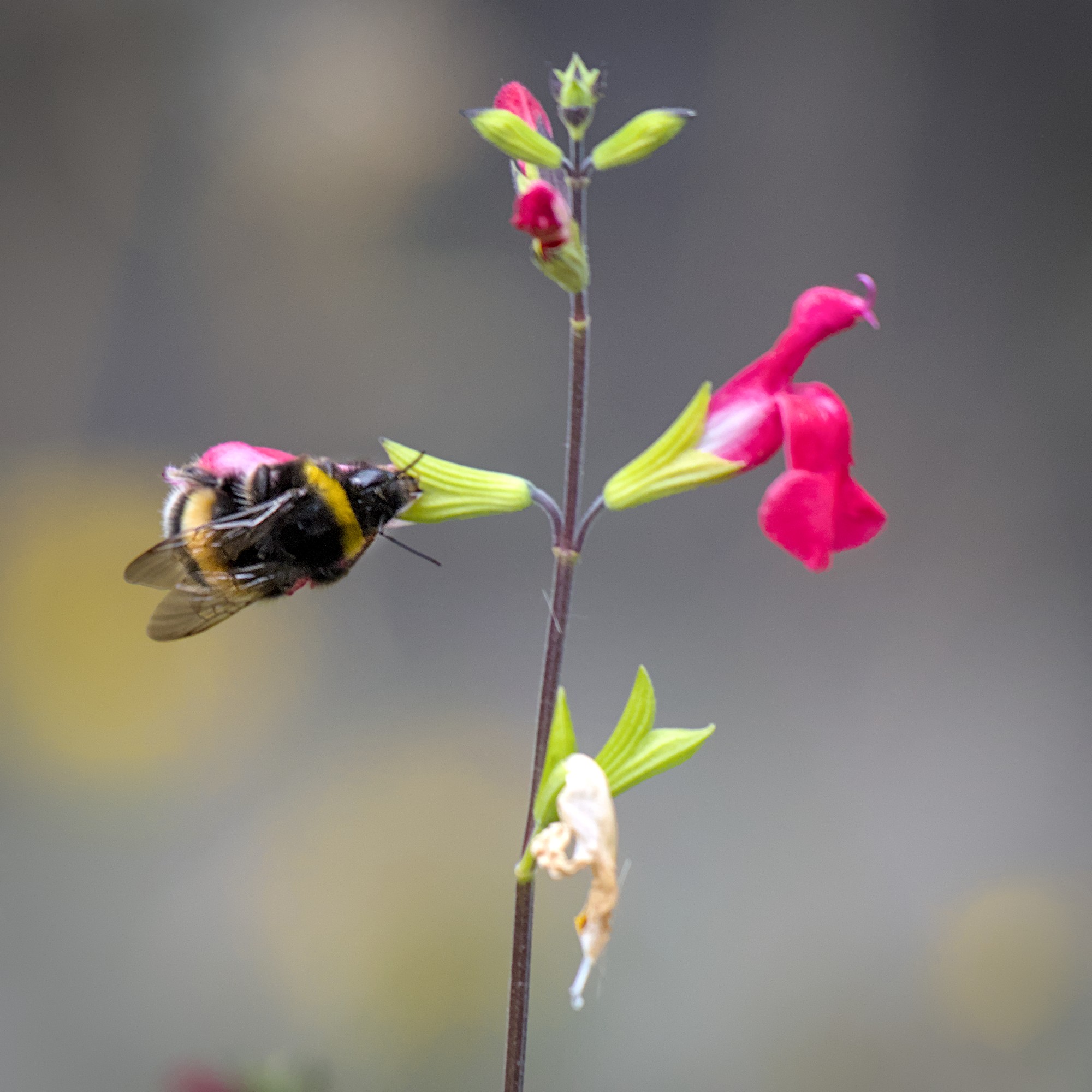
Buff-tailed or White-tailed Bumblebee — Bombus terrestris / Bombus lucorum (provisional ID — see note)
A wider context shot showing a bold black and yellow bumblebee working what appears to be the same or a very similar garden salvia as the close-up shot earlier. I like this image for the way it shows the plant in full — it gives a better sense of the foraging behaviour in its garden setting, and I think it pairs nicely with the tighter shot. The yellow bands and pale tail point toward either Bombus terrestris or Bombus lucorum, two species I find genuinely baffling to separate in the field.
- Scientific name: Bombus terrestris / Bombus lucorum
- Common name: Buff-tailed or White-tailed Bumblebee
- Plant: Garden Salvia — likely Salvia sp.
- Season: February–October
- Habitat: Gardens, meadows, farmland, hedgerows
- UK Status: Both species very common throughout Britain
- ⚠️ ID Note: These two are genuinely among the hardest bumblebees to separate — even experts sometimes decline to commit. I’d love to hear from anyone who can tell them apart from this image!
Image 13 — Honey Bee Reflection at Water
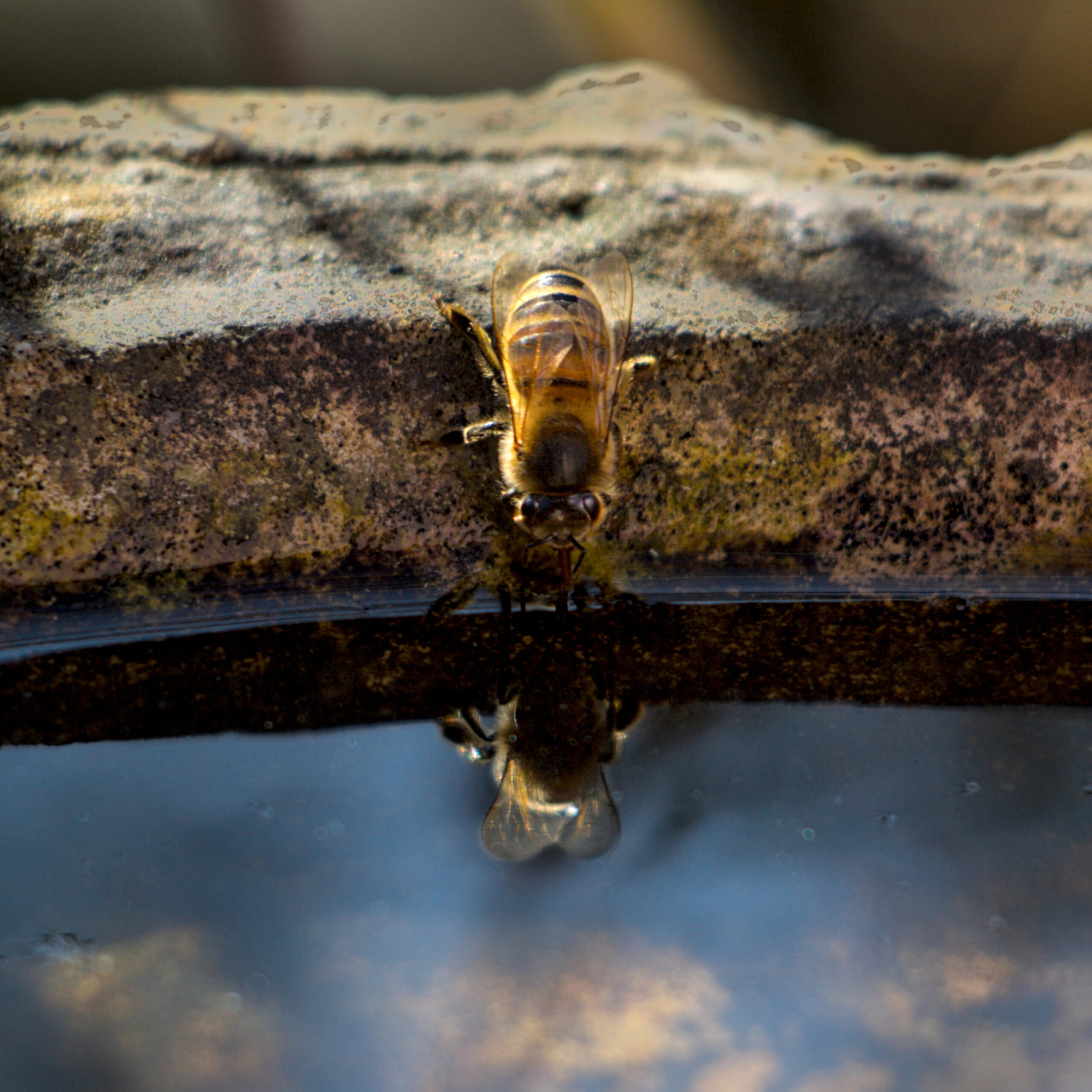
Western Honey Bee — Apis mellifera
One of my favourite shots in this gallery — a single honey bee perched at the edge of a garden water feature, its reflection perfectly mirrored in the still water below. Honey bees collect water regularly, particularly during hot weather, to cool the hive through evaporation — a colony can need a surprising amount on a warm summer day. The warm amber and banded abdomen, compact hairy body, and characteristic silhouette are all clearly visible and unmistakable. I was struck by how still the water was to give such a clean reflection.
- Scientific name: Apis mellifera
- Common name: Western Honey Bee
- Season: Active year-round in the colony; foraging workers March–October
- Habitat: Almost everywhere — closely associated with human habitation and agriculture
- UK Status: Very common; kept by beekeepers throughout the UK; also feral colonies in hollow trees
- ⚠️ ID Note: I’m confident this is a Honey Bee — the characteristic shape and colouration are quite distinctive at this scale.
Image 14 — Honey Bee at Pond (taken with Pixel 7a)
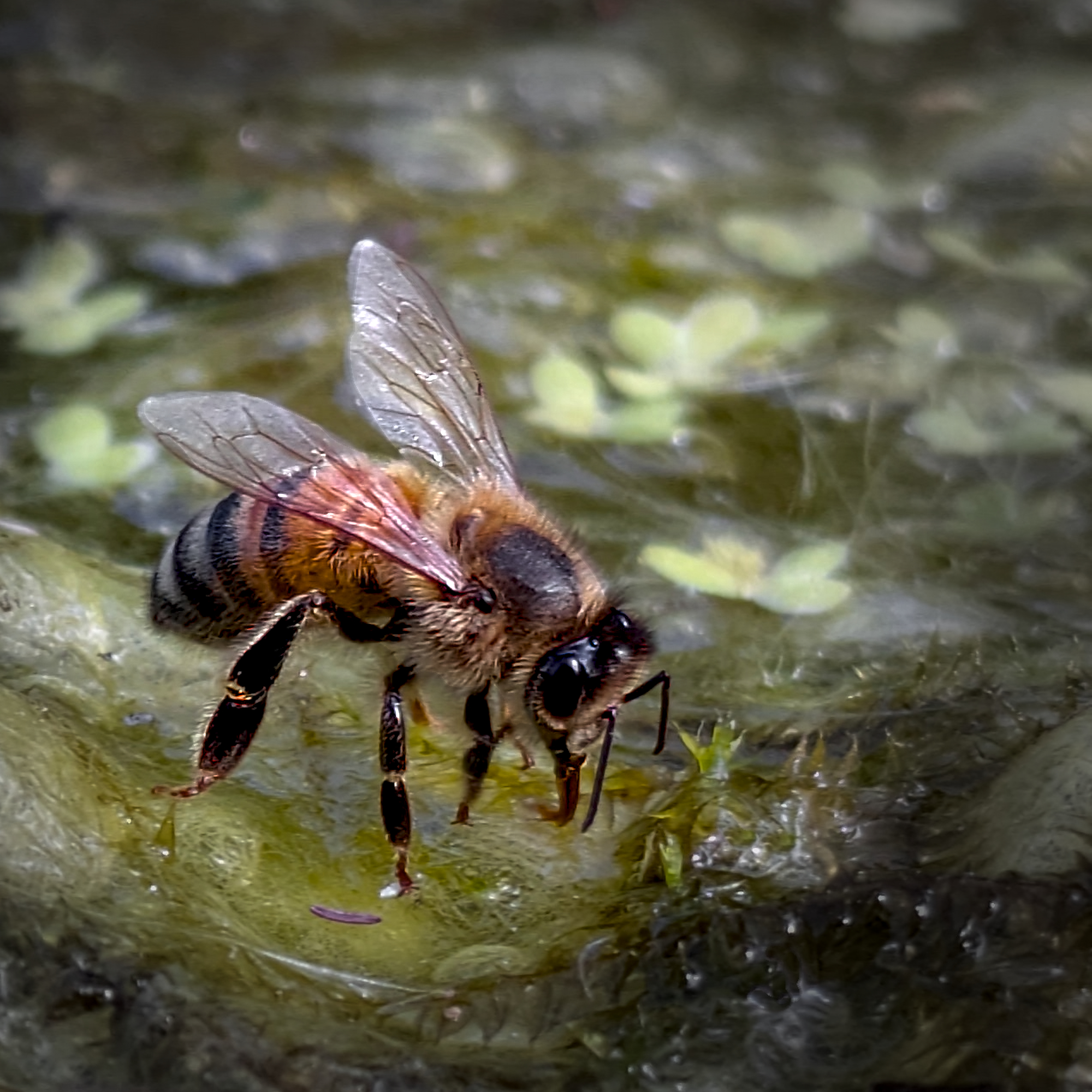
Western Honey Bee — Apis mellifera
Another honey bee at water, this time captured with my Pixel 7a phone — proof that the best camera really is the one you have with you. The bee is perched on algae-covered stone at the pond edge, wings partly spread, drinking from the surface. I’m genuinely pleased with the detail the phone has captured on the wings and body fur — the duckweed floating in the background and the algae-textured foreground give this an almost painterly quality I wasn’t expecting from a phone shot.
- Scientific name: Apis mellifera
- Common name: Western Honey Bee
- Season: Foraging workers March–October
- Habitat: Widespread — foraging up to several kilometres from the hive
- UK Status: Very common throughout Britain
- ⚠️ ID Note: Confident ID — Honey Bees are distinctive and well known. The water-collecting behaviour is a nice detail I was glad to capture.
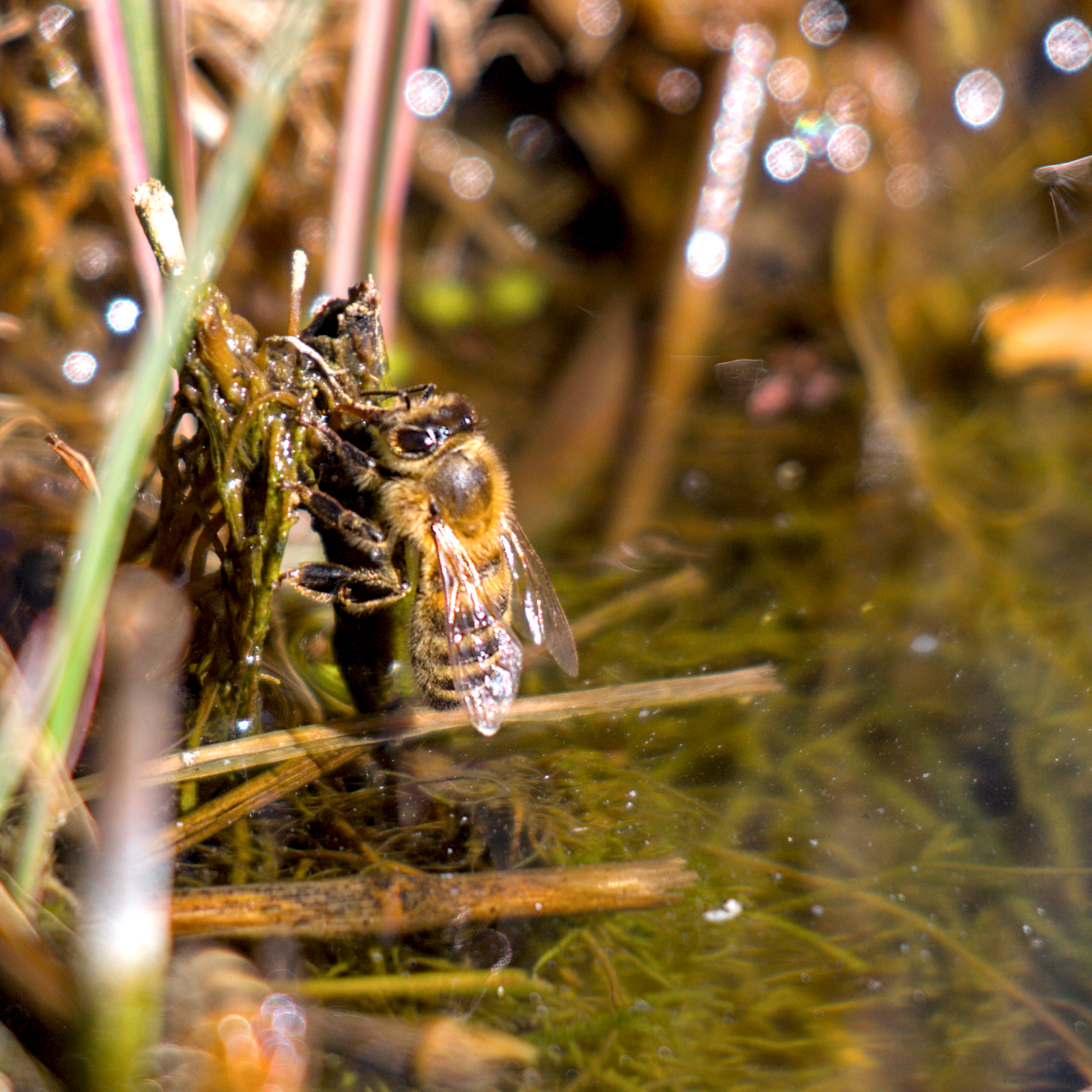
Image 15 — Bee in Pond Vegetation
Western Honey Bee — Apis mellifera — possibly in difficulty
A more dramatic scene — a honey bee clinging to submerged vegetation at the pond edge, clearly wet and potentially in difficulty. Bees occasionally fall into garden ponds while attempting to drink and can struggle to escape without a foothold. I have to confess I’m not entirely sure of the outcome here — if I’d realised at the time I’d have offered it a twig to climb onto. If you ever see a bee in this situation, a small escape ramp of pebbles or a floating cork near your pond edge can make a real difference. Despite the circumstances, the droplet hanging from the bee’s abdomen and the bokeh from water droplets in the background give this an almost ethereal quality.
- Scientific name: Apis mellifera
- Common name: Western Honey Bee
- ⚠️ ID Note: Confident this is a Honey Bee. A practical tip — a few pebbles arranged as a shallow ramp at your pond edge can save bees and other insects from drowning.
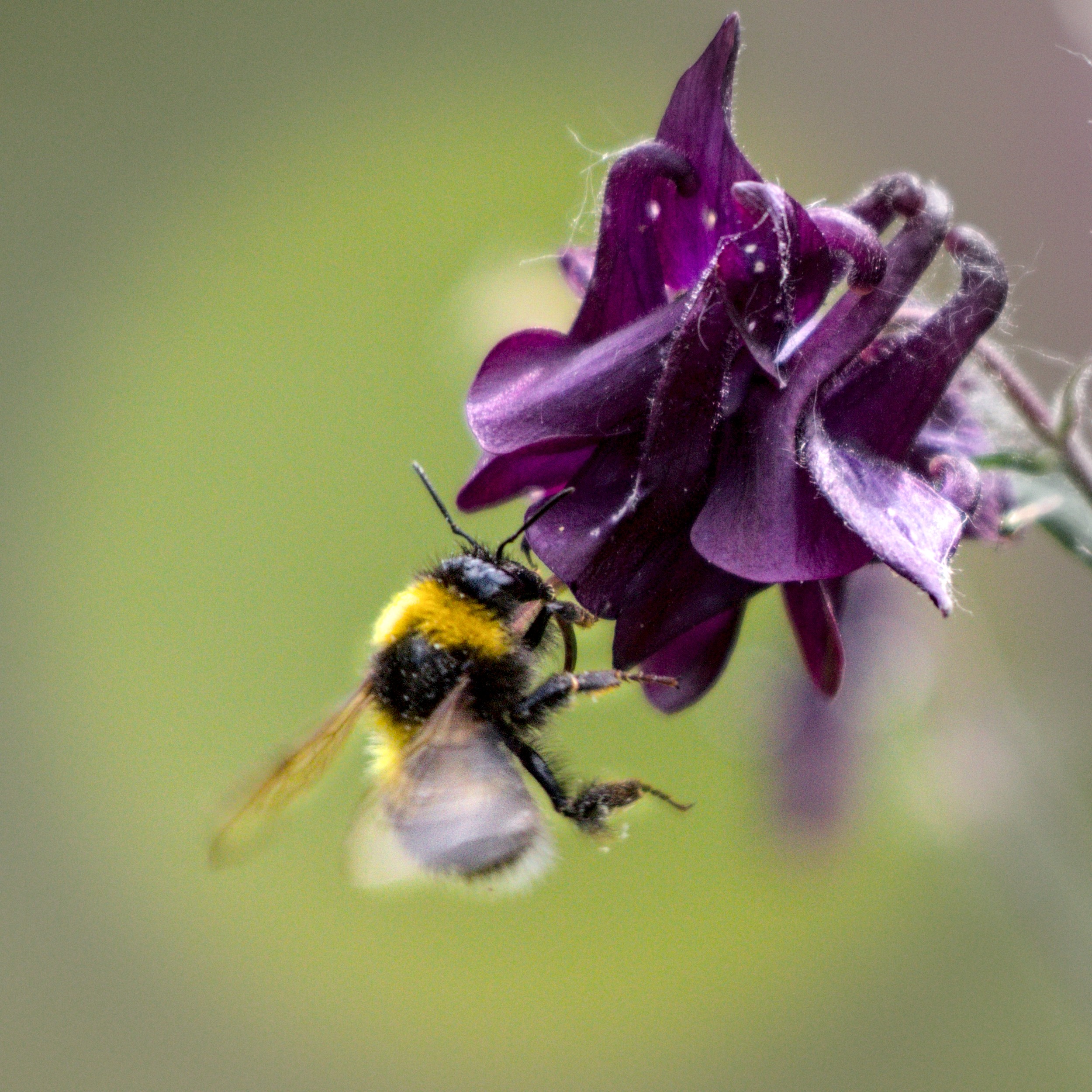
Image 16 — Bumblebee on Purple Aquilegia
Buff-tailed or White-tailed Bumblebee — Bombus terrestris / Bombus lucorum (provisional ID — see note)
A flight shot I was really pleased to get — a bumblebee hovering at a deep purple aquilegia (columbine) flower, wings a satisfying blur of motion. The yellow thoracic band and pale tail suggest Bombus terrestris or Bombus lucorum. Aquilegias are a favourite of long-tongued bumblebees — the spurred flowers hold nectar deep within, accessible mainly to bees with a sufficiently long tongue. Interestingly, some shorter-tongued species are known to cheat the system entirely by biting a hole in the spur to steal nectar without pollinating the flower — the insect world is full of such elegant solutions.
- Scientific name: Bombus terrestris / Bombus lucorum
- Common name: Buff-tailed or White-tailed Bumblebee
- Plant: Aquilegia / Columbine — Aquilegia sp. (garden variety)
- Season: April–September for aquilegia; bees active February–October
- Habitat: Gardens — aquilegia is a popular cottage garden plant and excellent for pollinators
- UK Status: Both bee species very common throughout Britain
- ⚠️ ID Note: As with other images in this gallery, separating these two species confidently requires very close examination — I’d welcome any expert input in the comments!
A general note: I’m an enthusiastic photographer and amateur naturalist rather than a trained entomologist, so please treat all identifications here as informed suggestions rather than definitive records. I warmly welcome corrections and additions in the comments below. If you want to contribute your sightings to science, both iRecord and iNaturalist have brilliant communities of experts who can help with tricky IDs — every record counts for UK wildlife monitoring.